
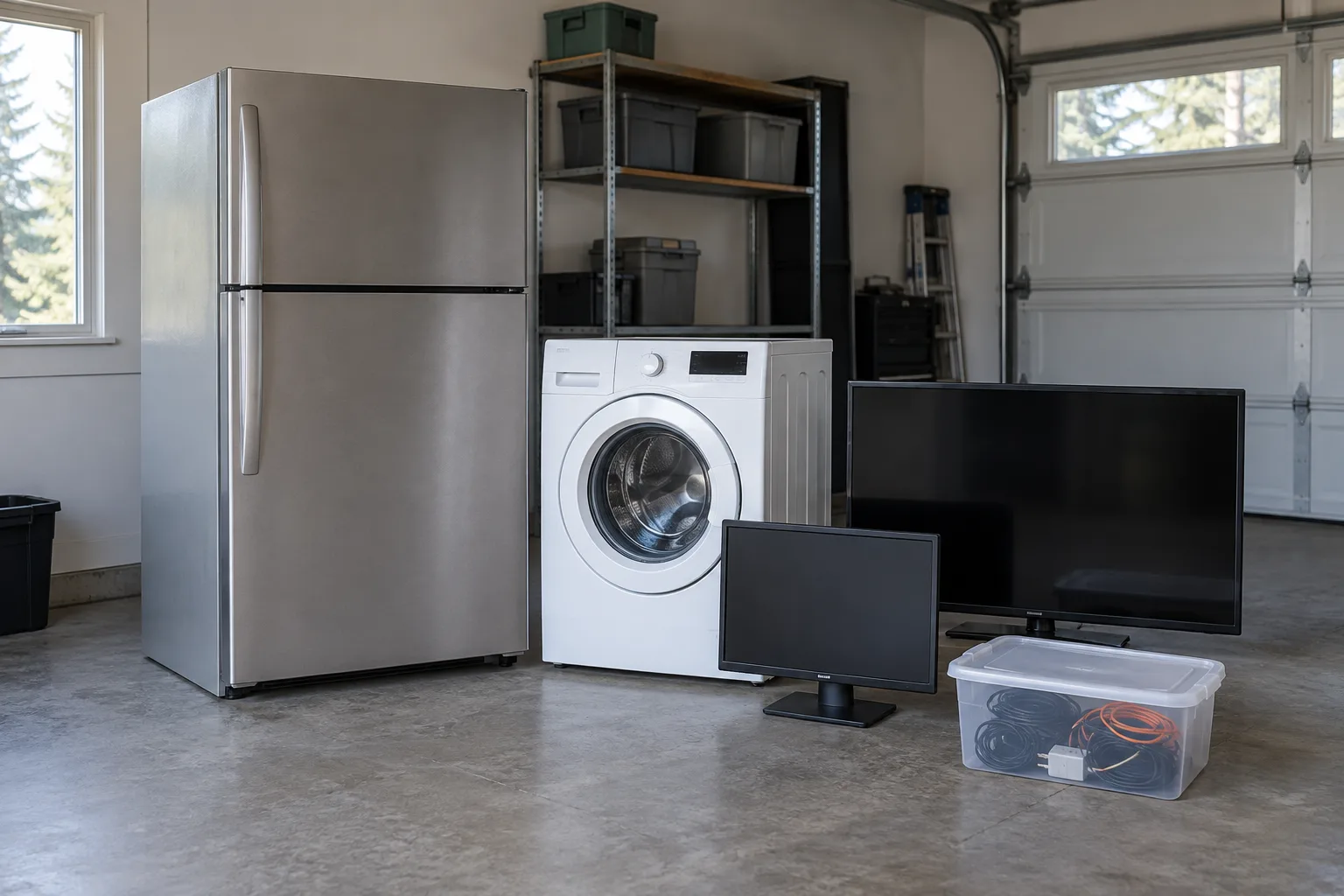
Sort the items before choosing a disposal route. Washington’s E-Cycle program covers specific electronics. Refrigerators and air conditioners involve refrigerants. Washers, dryers, printers, small electronics, and loose batteries follow other rules.
Choose the route by item, not by the word “electronic”
Write down the product type, size, condition, and whether it is damaged. A working laptop may be suitable for reuse after data is securely removed. A cracked television may need a collector willing to accept damaged screens. A refrigerator needs a route that handles refrigerant correctly.
What E-Cycle Washington covers
The Washington State Department of Ecology says eligible Washington households can recycle televisions, computers, laptops, monitors, tablets, e-readers, and portable DVD players at approved E-Cycle locations without a recycling fee. Home pickup and other premium services may still charge.
Keyboards, mice, printers, and many other peripherals are not part of the covered list. Ecology points residents to participating retailers or the 1-800-RECYCLE database for additional options. Call a collection site before driving over, especially for badly damaged equipment or more than ten covered items.
Refrigerant appliances are different
Refrigerators, freezers, air conditioners, and heat pumps can contain refrigerants. The City of Bothell’s 2026 recycling voucher program lists a $30 recycling fee for each refrigerant-type appliance at the Shoreline Recycling & Transfer Station, with eligible city residents able to request up to two $30 vouchers per year. The appliance must be empty. Voucher eligibility, facility rules, and fees should be checked before the trip.
Non-refrigerant appliances such as stoves, washers, and dryers may have different recycling fees or acceptance rules. Plastic-heavy dishwashers can be treated differently from scrap-metal appliances.
Prepare the item without taking it apart
- Remove food, water, personal property, and loose accessories.
- Follow manufacturer guidance for disconnecting power, water, or gas. Use a qualified trade professional when required.
- Do not cut refrigerant lines, drain fluids, break screens, or dismantle appliances.
- Back up and securely erase personal data from computers, tablets, and drives.
- Keep loose lithium batteries separate and protect terminals according to the receiving program’s instructions.
- Tell the pickup provider about stairs, tight turns, damaged glass, leaks, or unusual weight.
Quick decision table
| Item | Likely first check | Question to answer |
|---|---|---|
| TV, computer, laptop, monitor, tablet, e-reader | E-Cycle Washington location | Is the item covered and will the site accept its condition? |
| Refrigerator, freezer, AC | Refrigerant-appliance recycling or approved pickup | What fee, voucher, and preparation rules apply? |
| Washer, dryer, stove | Appliance recycler, transfer station, or pickup service | Is it accepted as scrap metal, and what access is involved? |
| Printer, keyboard, small electronics | Retailer program or 1-800-RECYCLE | Is this device accepted, and is there a fee? |
| Loose batteries | Battery-specific collection | What chemistry is it, and how must terminals be protected? |
For in-home removal, describe every item separately. A provider can then confirm whether it can be picked up, what special handling applies, and whether another local program is a better option.
Sources: Washington State Department of Ecology, E-Cycle Washington, and City of Bothell, Recycling Voucher Program. Retrieved September 16, 2026. E-Cycle is statewide; the voucher program is limited to eligible City of Bothell residents.